
This is the website of the European Federation of Shotokan Dojin-Kai Karate Dojos. Founded in 1976 by Yukio Matsumoto and other Karateka. The European Chief Instructor was Shihan Shojun Sugiyama, 9th Dan. He passed away in March 2025.
The new annual membership badges are available. Order them now and renew your membership in the Dojinkai Federation.


Shihan Shojun Sugiyama, 1950 - 2025
The Nippon Karate Do Shotokan Dojin Kai represents an independent and traditional Shotokan lineage with deep roots in Japan.
The organization was established in the 1970s by Master Matsumoto Yukyo, a direct student of Gichin Funakoshi, the father of modern Karate-Do.











In traditional Karate, the black belt has always represented more than technical ability. It reflects a long process of disciplined practice, clear standards, and steady personal development. This understanding guides our aim to uphold classical Shotokan principles while providing clear direction for today’s instructors and Dan holders.
Our curriculum brings together the essential elements of traditional martial arts with modern self-defence and health-oriented training, designed to support personal growth at every age.
Our program covers the full spectrum of traditional martial arts: Kihon (fundamental techniques), Kumite (partner work and controlled combat), Kata (formal sequences), and Bunkai (practical applications). These elements are complemented by effective self-defence training, developed for real-life situations and modern personal safety.
Our training welcomes all age groups and experience levels. We offer dedicated programs for children, a specialized and empowering training approach for women, and health-focused classes for adults seeking mobility, stress reduction, renewed energy, and practical self-defence skills.
This handbook provides a compact orientation for all Shotokan Dojin-Kai karate practitioners – from beginners to black belts. It contains the complete examination program and clearly shows which requirements apply to each belt level.
This handbook provides a compact orientation for all Shotokan Dojin-Kai karate practitioners – from beginners to black belts.
Structured according to the classical divisions of Kihon, Kumite, and Kata/Bunkai, it offers a clear guide for training and exam preparation.
It includes overviews of student and master grades, notes on examination regulations, and all programs from 9th Kyu to 1st Dan. Thanks to its ring-binder format, the handbook serves as a practical reference in the dojo – a reliable companion from white belt to black belt.
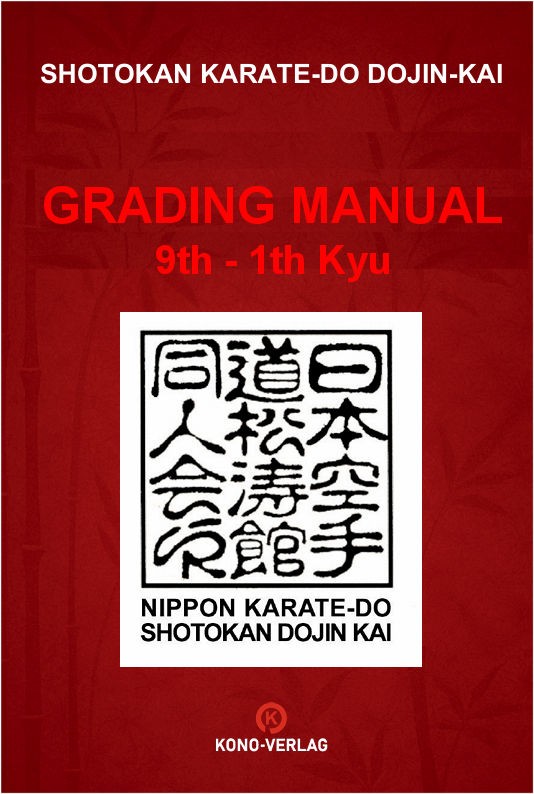
This handbook contains the complete examination program and clearly shows which requirements apply to each belt level.
🇩🇰 | 🇮🇪 | 🇬🇧 |
🇮🇹 | 🇦🇹 | 🇨🇭 |
🇧🇪 | 🇩🇪 | 🇳🇱 |
The Nippon Karate Do Shotokan Dojin Kai is an independent, traditional lineage within Shotokan Karate, with its roots firmly grounded in Japan. The organization was established in the 1970s by Master Matsumoto Yukyo, a direct student of Gichin Funakoshi, the father of modern Karate-Do. Matsumoto belonged to the early post-war generation of karateka who trained closely under Funakoshi and helped carry his teachings into the following decades. Out of this direct transmission, a distinct Shotokan line emerged, deliberately positioned outside the major organizational frameworks such as the JKA or Shotokai.
The official headquarters (Honbu Dojo) of Dojin-Kai is located in Hamamatsu, a major city in Shizuoka Prefecture on the island of Honshū. From this base, the technical profile of the style was developed and preserved. Leadership later passed to Master Tsuyoshi (Stuyoshi) Matsumoto, the son of the founder, who now serves as the current president of the Nippon Karate Do Shotokan Dojin Kai. At the Honbu Dojo in Hamamatsu, he continues to uphold traditional Shotokan training and maintains the connection between the Japanese headquarters and the affiliated dojos around the world.
Although its origin is clearly Japanese, the organizational strength of Dojin-Kai grew especially through its international branches. In Europe—particularly in Italy, Germany, and UK - and in parts of Asia such as India, solid structures developed over the years. These groups played a significant role in carrying forward the technical legacy of the Matsumoto family. A central figure in this international expansion was Shihan Shojun Sugiyama (9th Dan), who served as the leading instructor for Europe for many years. His work profoundly shaped the presence of Dojin-Kai on the continent, ensuring that it remains one of the notable traditional Shotokan streams in Europe today.
Today, Dojin-Kai dojos around the world remain relatively rare and are often the result of decades of personal teaching journeys undertaken by Shihan Shojun Sugiyama. Through his continuous travel and direct instruction, he established and nurtured small but dedicated communities of practitioners across different continents. Dojin-Kai is represented in Japan, and also in countries such as India, Sri Lanka, Italy, Germany, Belgium, Ireland, Scotland, England, Denmark, and even in Rwanda in East Africa, among others. These locations reflect a global network that is modest in size but strong in spirit, built primarily through personal relationships, direct mentorship, and long-term commitment rather than large-scale organizational expansion.

